WASHINGTON — Chinese President Xi Jinping arrived in Washington on Wednesday, where he was met with a rare planeside greeting from President Donald Trump after the two countries' top officials agreed to extend a trade truce until January.
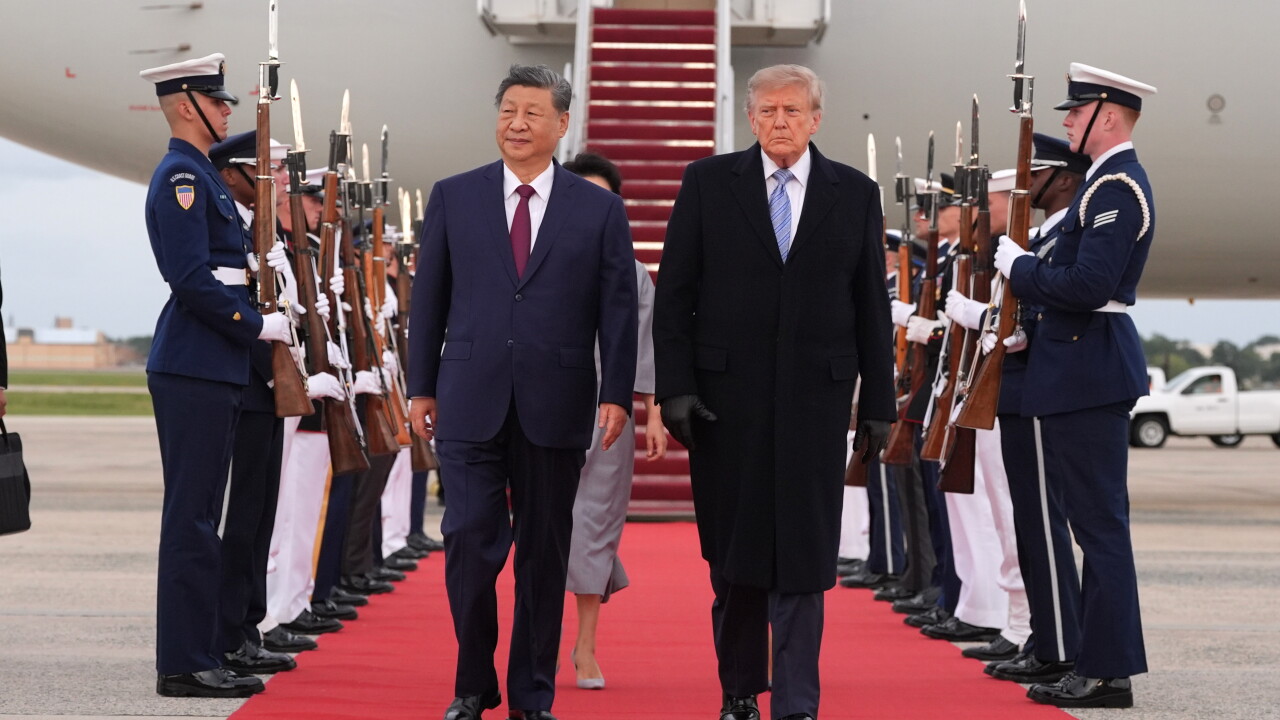
Trump, joined by first lady Melania Trump, greeted Xi and his wife, Peng Liyuan, at Joint Base Andrews just outside Washington — a gesture U.S. presidents rarely make, rather than waiting to receive a visiting leader at the White House.
A 100-foot red carpet was unfurled at the bottom of the staircase placed at the door of Xi's plane. A 21-person honor guard lined the carpet as the Trumps shook hands with Xi and Peng. Two American children presented bouquets of yellow flowers to the Chinese leader and his wife. The ceremony included a flyover by two B-1 bombers, platoons from each U.S. military service, and the presentation of the flags and anthems of both countries. Trump, who wore gloves and an overcoat though it was a relatively warm 63 degrees outside, removed one glove to shake Xi's hand — and at one point slapped him on the back.
"I think they appreciate it, tremendous people," Trump told reporters after returning to the White House on Wednesday evening, describing the greeting.
The first lady said earlier Wednesday that her husband decided to personally greet Xi because "they have a great relationship."
"He's coming on our soil, and we need to welcome them with the most respect," she said in an interview on Fox News Channel's "Fox & Friends."
The visit is Xi's first state visit to the U.S. capital in more than a decade, according to the Associated Press.
As Trump welcomed Xi, Treasury Secretary Scott Bessent announced on Fox News that the two countries had agreed to extend their trade truce — under which they scaled back tariffs and refrained from imposing new trade restrictions. Bessent said the "Busan Agreement," an economic détente that had been scheduled to expire on Nov. 10, will now run until Jan. 10.
"I don't know whether a bigger deal can be done. I don't know whether we will just roll the current deal," Bessent said, adding that the extension could give the leaders more time to talk at upcoming international summits in China in November and Florida in December.
Bessent also acknowledged that some Chinese deliverables under the agreement "have not been perfect," saying the U.S. wants to see its expectations met. China had wanted a longer extension, but analysts said the short window lets Washington test whether Beijing delivers on unmet promises — including purchases of U.S. farm goods and critical mineral exports.
Trade has been one of the biggest flashpoints between the two superpowers, along with artificial intelligence, the U.S. conflict with Iran, fentanyl exports, and China's designs on Taiwan. The three-day visit is expected to cover trade, Taiwan, and AI — though much of it will be heavy on ceremony.
Not everyone in Washington is cheering the pageantry. Sen. Roger Wicker, chairman of the Senate Armed Services Committee, criticized the "lavish welcome," saying Trump should not have invited the Chinese leader "based on all of the troubling issues we have with President Xi and the Chinese Communist Party."
Danny Russel, a former U.S. diplomat now at the Asia Society Policy Institute, said the airport pomp delivered a propaganda win for Beijing: "Such extreme deference is valuable evidence that China's leader is now held in extraordinarily high esteem by the President of the United States."
Additional events during the trip are expected to include a state dinner at the White House on Thursday with tech industry leaders — including Nvidia's Jensen Huang and SpaceX's Elon Musk, according to the AP — a military arrival ceremony and review of troops, and on Friday a private tea with the Trumps followed by a tour of the National Archives, home of the original Declaration of Independence and Constitution.
Secretary of State Marco Rubio said the U.S. and China must engage at the highest levels because the two countries are "the two largest economies in the world" and "probably the two most powerful militaries in the world."
The Washington visit is the second in-person meeting between the leaders this year, following Trump's summit with Xi in Beijing in May. Trump on Wednesday was looking to match the pageantry he received in China — though Xi had not met him at the airport in Beijing; Chinese Vice President Han Zheng was there instead.
- National Correspondent Network