
MINNEAPOLIS — Minneapolis Public Schools could close as many as 16 school buildings under a sweeping restructuring plan unveiled this month, a move that would reshape the city's educational map and displace thousands of students.
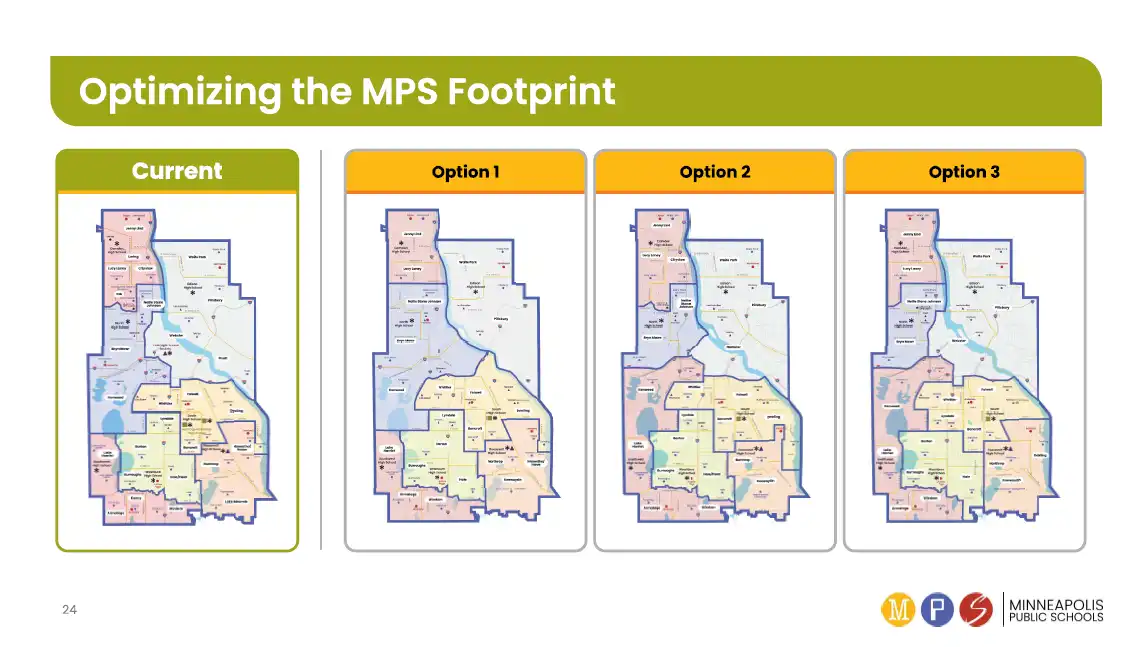
Superintendent Lisa Sayles-Adams presented three "transformation" proposals to the school board on September 15, each one closing or consolidating schools across the district. All three plans would end existing academic programming at 14 schools, with two additional buildings — Cityview and Webster — affected under some options, bringing the potential total to 16.
Why now
The district says the math no longer works. Enrollment has fallen below 30,000 students, but the district's buildings were built to hold roughly 42,000 — leaving thousands of empty seats. At the same time, MPS faces a budget deficit of about $39.7 million this year.
District leaders argue that half-empty buildings can't sustain full programming — art, music, gym and electives — and that consolidating students into fewer, fuller schools would give more kids access to complete academic programs. The district says class sizes would not change and that the goal is to attract more funding, not simply cut costs.
The district has been discussing a "transformation" of its real estate since 2023. Notably, Deputy Superintendent Ty Thompson said addressing long-term financial challenges was not part of the board's directive for these specific proposals.
Which schools are on the list
The 14 schools included in all three proposals are Anwatin Middle School, Bethune Arts Elementary, FAIR School for Arts, Field Elementary, Heritage Academy, Hiawatha Elementary, Hmong International Academy, Kenny Elementary, Lake Harriet Lower, Lincoln, Longfellow, Loring Elementary, Pratt Elementary and Wenonah Elementary.
The closures would hit the north and southwest parts of the city hardest. The district has promised "pathway continuity" even where buildings close — for example, the Hmong language pathway would continue at Jenny Lind, and a Somali pathway would continue at Edison if Heritage closes.
Rather than calling them closures, the district uses the term "unprogramming," saying buildings that lose their current academic programs could be repurposed in the future.
Pushback
Parents and educators have reacted with alarm. Principals at affected schools were notified shortly before the September board meeting. The Minneapolis Federation of Educators labeled the proposals "worst-case scenarios," and parents packed early feedback sessions with concerns about longer commutes, broken neighborhood ties and uncertainty over where their children would land.
Even inside the boardroom, the politics are raw — board member Greta Callahan called the options "offensive."
What happens next
Nothing is final. The school board has not voted, and district officials are gathering public feedback first. Community meetings run from September 30 through October 9 at high schools across the city — the public's first structured chance to weigh in.
A final board vote is expected no later than November 10, 2026 — after school board elections and before next year's enrollment process. If a plan is adopted, changes would take effect in the 2027-28 school year, affecting an estimated 14 percent of the district's students.
NCN will continue following this story as community meetings unfold and the board moves toward its November vote.
- National Correspondent Network

