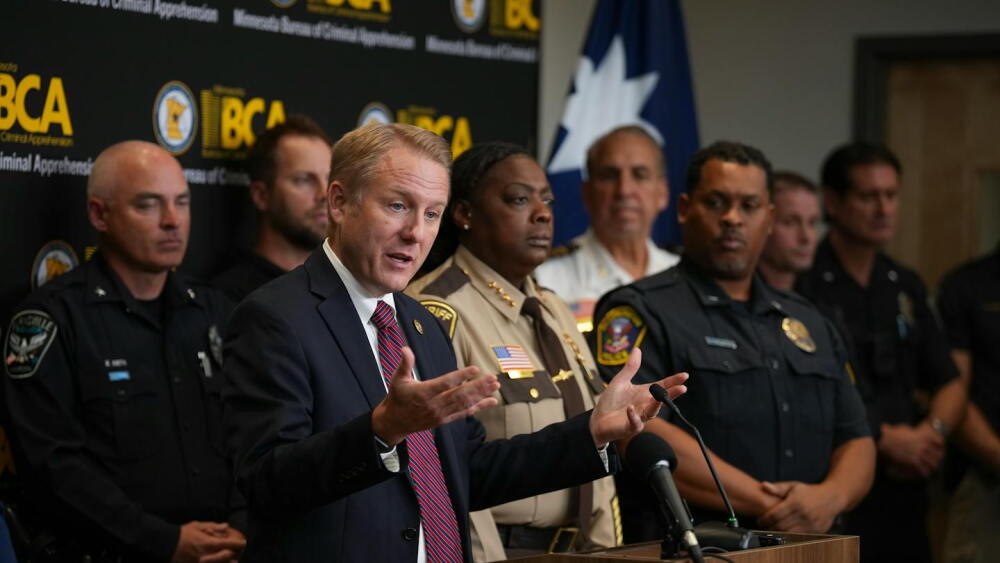
MINNEAPOLIS — Leaders of 46 local, state and federal law enforcement agencies announced a shared framework on Monday to coordinate investigations and intelligence in response to recent gang and group violence across the Twin Cities metro, according to the Minnesota Bureau of Criminal Apprehension (BCA).
The effort will run under the umbrella of Minnesota's Crime Gun Intelligence Center, which is run by the BCA, the FBI and the federal Bureau of Alcohol, Tobacco, Firearms and Explosives (ATF). The center will help agencies share information about gang-related crimes across jurisdictional lines and determine which agency is best suited to assist in each case, BCA Superintendent Drew Evans said at a Monday news conference.
Evans said police are dealing with a changed problem: unlike the more organized gangs of decades past that concentrated in specific areas, officials say today's groups are loosely organized, highly mobile, and fight over social media clout rather than drugs or money — crossing city lines and pulling multiple agencies into the same cases.
"It's a new and emergent issue in terms of how decentralized it is and impacting so many communities across the Twin Cities, and that requires an approach that's unique compared to some of the things that we've done in the past," Evans said.
Officials were explicit that the plan is not a new standalone task force. As opposed to creating one, Evans said the shared framework "hits the ground running right now" when it comes to collaboration and sharing resources. The approach follows an information-sharing strategy introduced in New Jersey 20 years ago, according to FOX 9. Evans did not rule out a single regional task force in the future if the violence persists, and he said the Crime Gun Intelligence Center will now meet weekly instead of every other week.
The announcement follows a string of shootings police have linked to loosely organized groups of Somali teenagers and young men, including shots fired outside Our Lady of Grace Church in Edina on Sept. 22, the Oct. 2 shooting outside an Eden Prairie High School homecoming football game in which an 18-year-old man allegedly shot and injured two people, and a shooting days later outside a Bloomington home where roughly 100 rounds were fired — an incident police suspect was retaliatory, according to the Star Tribune.
Federal officials said the full range of federal tools is available. "RICO … is a federal statute that we could levy against gangs and conspiracies," said FBI Special Agent in Charge Chris Dotson, referring to the Racketeer Influenced and Corrupt Organizations Act. "It's on the table, but it's again just one tool of several, federally, that we can bring." Federal prosecutors used the law earlier this year to indict and convict dozens of members of the Highs and Lows gangs in north Minneapolis, according to FOX 9. ATF Special Agent in Charge Joe Persails said the ATF has restructured so that one of its Minnesota enforcement groups is now exclusively focused on investigating gang-related violence, according to the Star Tribune.
Hennepin County Sheriff Dawanna Witt also announced the Hennepin Enhanced Enforcement Team, a county unit drawing detectives, officers, investigators and analysts from the Hennepin County Sheriff's Office, Minneapolis police, the University of Minnesota Police Department and the ATF, according to the BCA and reporting on the news conference.
Speaker after speaker paired the enforcement message with a direct appeal not to blame an entire community. "Somali American gang and group violence is a problem and the Somali community is not the problem," Evans said.
Witt said she has been appalled by the "hatred" directed at the Somali community after the shootings. "All the hatred that we've been seeing coming through social media channels, blaming entire communities for the actions of some, is absolutely ridiculous, unneeded, unnecessary," Witt said.
Bloomington Police Chief Booker Hodges addressed suspected gang members directly. "Those of you who are doing this: We love y'all; we don't want to see y'all dead," Hodges said. "We don't want to see you kill somebody else, and if we've got to put you in jail to make sure you don't do that, that's something that we'll do."
Dotson said communication with community leaders matters as much as communication between agencies. "Community leaders know the problems facing their neighborhood, maybe better than anyone," he said. "Working with our community partners is not only the smart thing to do, it's the right thing to do." Separately, Somali American officers from several local agencies held a listening session with parents on Sunday night and objected to the word "gangs" being used to describe the youth violence, according to reporting on the session.
Ramsey County Sheriff Bob Fletcher, who has publicly warned about Somali gangs since July, said he backs the new plan. "It's really key — let's get all the information shared," Fletcher said, adding that his office believes there are now 13 Somali gangs in the area and that gang activity has quieted since the Oct. 6 Bloomington shooting. Hennepin County Attorney Mary Moriarty said in a statement that her office has been part of the recent meetings and supports the plan: "Our office is pleased to be a partner in this framework to address the drivers of gun violence, especially the focus on using and sharing data."
The framework is the outcome of a push NCN has followed for weeks: Chief Hodges' Oct. 6 news conference urging a coordinated response, Sheriff Fletcher's remarks the same week, and an Oct. 7 planning meeting between the BCA and roughly 40 agencies on a possible regional approach. Officials on Monday chose the shared-framework route — building on existing task forces and resources rather than standing up a new one.
Officials did not announce public benchmarks or a timeline for measuring whether the strategy is reducing shootings, and Evans said the agencies are not using a single shared database to track gang members, according to FOX 9. NCN will continue following the rollout of the framework and any future decision on a regional task force.
- National Correspondent Network