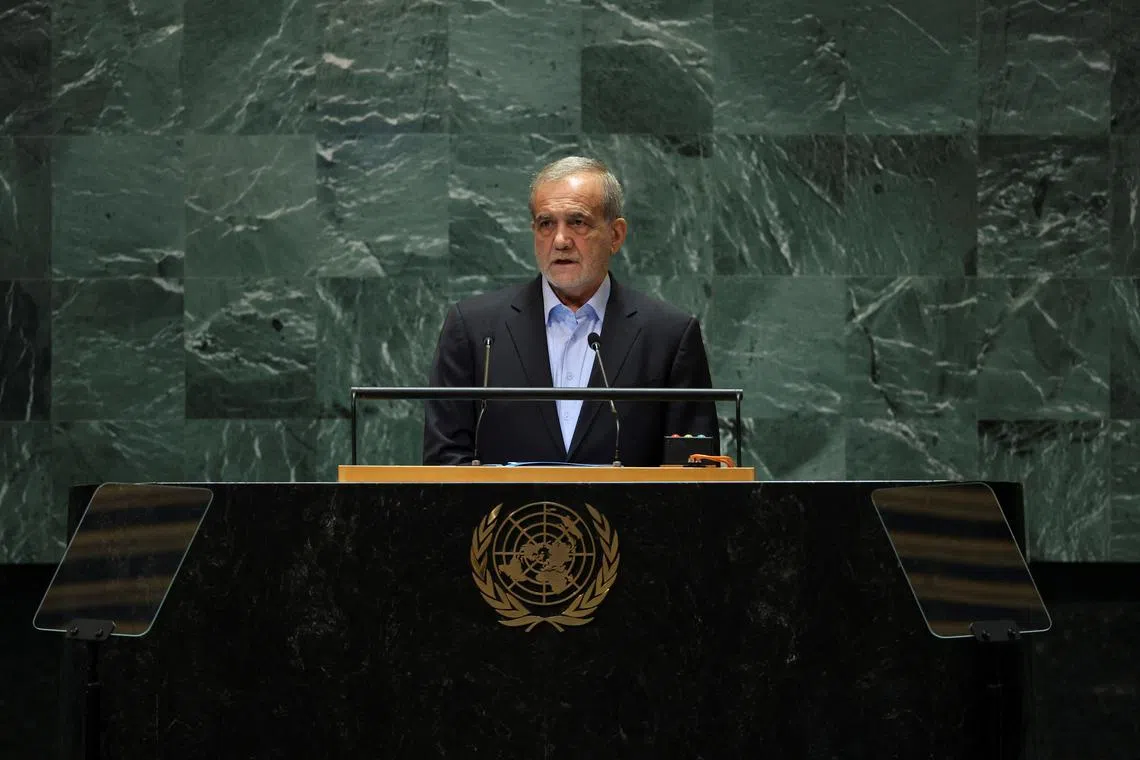
NEW YORK — One day after President Donald Trump stood before the United Nations and threatened to "annihilate the Islamic Republic," Iranian President Masoud Pezeshkian took the same podium Wednesday and delivered Tehran's answer: defiance.
"They have learned that Iran cannot be made to surrender," Pezeshkian said. "We will never bow our head or bend at the knee."
It was a rare historic moment, the Associated Press noted — the first time a foreign leader whose country is at war with the United States has traveled to New York to address the General Assembly. Seven months after the U.S. and Israel launched a war on Iran, Pezeshkian spoke on American soil in an enemy country still fighting his own.
Pezeshkian said Trump's rhetoric caused him to rewrite the speech he had prepared before traveling to New York. What he delivered instead received near-unanimous praise in Iranian media, even from hardline publications, according to CNN.
"Yesterday the United States president described us as terrorists. We have been the victims of terrorism," Pezeshkian told the assembly.
In one of the speech's most striking moments, he held up a portrait of the late supreme leader, Ayatollah Ali Khamenei, who was killed on the first day of U.S.-Israeli attacks on Iran on Feb. 28. He then held up photographs of children he said were victims of U.S. and Israeli bombings.
"Our innocent people have been the targets of cowardly attacks and aggressions imposed upon our country, and we defended ourselves with utmost strength," he said.
On the nuclear question at the heart of the war, Pezeshkian drew a firm line in both directions.
"I hereby declare once more before this assembly that Iran has never sought and will never seek to build a nuclear bomb," he said. "We do not seek nuclear weapons."
But he refused any limitation on Iran's civilian nuclear program — "We seek energy for progress" — and insisted Iran must stay strong. "Iran must be powerful so as to avoid being threatened, to avoid its future being threatened," he said.
He turned the scrutiny back on Israel: "The nuclear bomb is in Israel, but the inspectors are in Iran! Israel kills, but Iran is sanctioned!" He accused Israel of abandoning diplomacy for force — "they impose their presence through naked force, and have styled it peace through strength" — and condemned talk of a "greater Israel" after what he called "nearly two years of genocide" in Gaza.
Pezeshkian also condemned the United Kingdom, France and Germany for launching a 30-day process on Aug. 28 to reimpose UN sanctions on Iran over its nuclear program — a process that ends Sept. 27. He accused the European powers of acting "at the behest of the United States" and of portraying Iran's lawful responses to the U.S. withdrawal from the 2015 nuclear deal as violations.
On the Strait of Hormuz, the vital waterway through which a fifth of the world's oil once flowed, Pezeshkian said Iran would continue to lay claim to it.
"We cannot let some have free access and gain their interest from a waterway while at the same time using that waterway to impose their aggressions upon us, to impose insecurity upon us, to forbid us access to our own waterways," he said.
He offered Iran's neighbors a message with an edge: the region's security is indivisible, and without guarantees for Iran, all will "live under insecurity together." One expert told CNN the message carried an implicit threat — continued pressure would impose costs across the region.
A lone American delegate walked out of the assembly shortly after Pezeshkian's speech began — a mirror image of Tuesday, when Iranian diplomats walked out during Trump's address.
The speech landed one day after Trump's envoys Steve Witkoff and Jared Kushner held three hours of mediated talks with Iranian Foreign Minister Abbas Araghchi in New York, brokered by Qatar. Secretary of State Marco Rubio said Wednesday the talks were no major breakthrough and that the earlier memorandum of understanding was no longer on the table — but added: "I think it was significant that at least there was a conversation."
U.S. Ambassador to the UN Mike Waltz told NPR the administration is "internalizing what they brought to the table." Iran's Foreign Ministry spokesman Esmail Baghaei said an exchange of messages took place with Qatar as mediator, with Iran's conditions including a halt to U.S. hostilities, an end to the naval blockade, and the release of Iranian funds.
But hard-liners in Tehran are pushing back on the diplomacy. Lawmaker Ebrahim Rezaei publicly questioned on what authority Araghchi met "the representative of the aggressor enemy." And Iran's Supreme National Security Council chief, Mohsen Rezaei, told state media that Tehran will adopt a new negotiating framework requiring Washington to take the first step — with any future talks or reopening of the strait contingent on full implementation of Iran's demands.
Even as diplomacy flickered at the UN, the war continued. Oman's Maritime Security Center said a ship was targeted near the Strait of Hormuz, killing one person, and the UK Maritime Trade Operations center advised vessels to "transit with caution."
The human toll keeps climbing. The U.S. Army on Wednesday identified the 19th American service member to die in the war: Capt. Bianca C. Wilkerson, 37, of Norfolk, Virginia, who died Sept. 18 in what the Army called a non-combat-related incident.
Israeli Prime Minister Benjamin Netanyahu is due to land in New York on Thursday to address the General Assembly before flying home. New York Mayor Zohran Mamdani dropped his threat to arrest Netanyahu on an outstanding International Criminal Court warrant, saying the city did not have jurisdiction.
- National Correspondent Network